
The Invention of the Morris Rod-Weeder National Historic Event
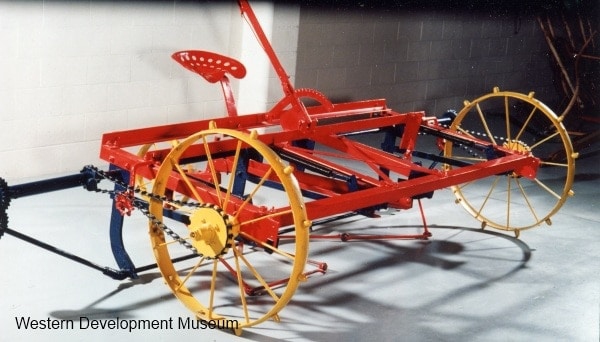
© Saskatchewan Western Development Museum / WDM-1973-Y-2834
The invention of the Morris Rod-Weeder was designated as a national historic event in 2025.
Historical importance: specialized farm implement for weed control, represents farming innovation in Canada’s agricultural industry, ideally suited for efficient dryland farming in Canada’s prairie drought conditions in the 20th century.
Commemorative plaque: no plaque installedFootnote 1
The Invention of the Morris Rod-Weeder
Invented by George Morris in 1929 in Bangor, Saskatchewan, the Morris Rod-Weeder was a specialized farm implement designed to efficiently remove weeds from soils laden with rocks. Suited to the dry conditions of the Canadian Prairies, this implement helped prevent soil drifting and conserved moisture, supporting Canadian farmers during the Great Depression and for decades after. For almost 50 years, the Morris Rod-Weeder represented farming innovation in Canada’s agricultural sector and demonstrated how individuals, using their personal experiences, spurred the industry. The utility and popularity of this technology gave rise to the Morris Rod-Weeder Company in 1930, a successful Canadian farm implement manufacturer that sold various versions of the rod weeder in Canada and abroad into the 1970s, when it was replaced by other forms of weed management.
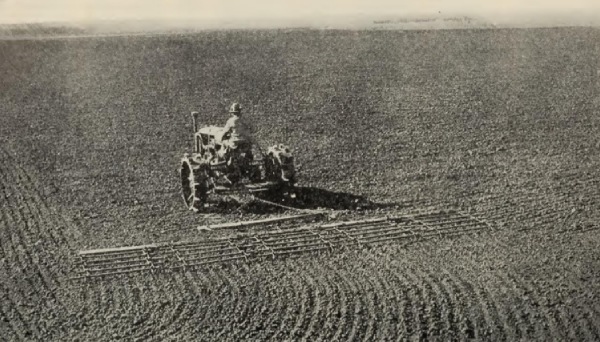
© E.S Hopkins, S. Barnes, A.E. Palmer & W.S. Chepil. Soil Drifting Control in the Prairie Provinces. Dominion of Canada - Department of Agriculture Bulletin, No. 179, Ottawa, 1935, 2
The Morris Rod-Weeder significantly impacted farming practices on the Prairies, particularly in the challenging conditions of the Palliser Triangle. Morris, a mechanic and farm implement dealer, developed the rod weeder to address the difficulties of dry, rocky, and windy farming environments. His invention featured a unique metal-framed rod equipped with an automatic spring-loaded trip device, allowing for effective weed control with minimal disturbance to the topsoil and automatic resumption of work after encountering underground obstacles.
The Morris Rod-Weeder effectively responded to a growing body of agricultural knowledge distinct to the Prairies. Based on the belief that it preserved soil moisture, a previous popular farming technique involved pulverizing topsoil into a fine dust. However, this had an unfortunate effect on the windswept prairies as topsoil was easily carried off by the wind, amplifying the intensity and frequency of dust storms. In combination with the low-moisture growing conditions characteristic of several regions in the Prairies, this devastated crops and created hazardous living conditions for farmers. During the 1920s, the federal government’s Experimental Farm scientists identified “trash-cover farming” as a suitable technique for dryland farming. This technique involved minimal soil disturbance, which conserved moisture and prevented erosion. The Morris Rod-Weeder exemplified this new farming practice because of its low-impact tillage technology, which sheared underground weed roots, left the stubble in place, and maintained soil integrity. Unlike other rod weeders of the time, Morris’s design included springs and an automatic return mechanism, preventing damage to the machine and eliminating the need for farmers to manually reset the implement after hitting stones.
The Morris Rod-Weeder was a symbol of agricultural innovation in Canada, showcasing how practical experience and continuous improvement could lead to significant advancements in farming technology. By 1933, manufacturing was contracted out to a firm in Portage la Prairie, Manitoba. The company relocated to Yorkton, Saskatchewan, in 1949, where Morris and his team continued to innovate, adding features like the two-implement hitch and the hydraulic wing-lift to take advantage of the increasing power of tractor engines. The Morris Rod-Weeder was produced in various models, ranging from six to 36 feet wide, and sold across the Prairie provinces of Canada and the Northern United States.
“There was brilliance in the ingenuity of the rod-weeder, a tool that helped farmers address weed control on their fallow fields with minimal soil disturbance, a timely intervention to fight the legendary droughts. What made George Morris’ invention special, though, was its logical adaptation to Canadian prairie fields, developing the trip mechanism which saved the rod-weeder from bending and twisting on the rocks which rise through the soil profile every year via frost heaves and cultivation. Farmers loved Morris’ combination of precision and practicality."
This press backgrounder was prepared at the time of the Ministerial announcement in 2025.
The National Program of Historical Commemoration relies on the participation of Canadians in the identification of places, events and persons of national historic significance. Any member of the public can nominate a topic for consideration by the Historic Sites and Monuments Board of Canada.
- Date modified :