
West Coast Trail Unit - Management planning
Pacific Rim National Park Reserve
The West Coast Trail Unit management planning working group appointed by the leadership of Huu-ay-aht, Ditidaht, and Pacheedaht First Nations, and Parks Canada is analyzing the feedback they received during the engagement and consultation processes for First Nations communities and the public. Once the analysis is complete, the working group will share a summary on this page.
Thank you for sharing your feedback with us
On this page:
- Engagement and consultation
- What we heard
- Working together in the West Coast Trail Unit
- Executive Summary: State of the West Coast Trail Unit Report, Pacific Rim National Park Reserve (2023)
Engagement and consultation
Public engagement and consultation – February – March 2026
Through a variety of events and an online survey, interest-holders and the public were informed about the co-development of the plan and were invited to provide feedback on the strategies.
First Nations engagement and consultation – November – December 2025
Through a variety of events and an online survey, Huu-ay-aht, Ditidaht, and Pacheedaht First Nations community members and citizens were informed about the co-development of the plan and were invited to provide feedback on the strategies.
What we heard
Once both engagement and consultation processes are complete, the West Coast Trail Unit management planning working group will share a summary of the feedback. Your feedback will be considered in subsequent steps in the management planning process.
Please check back for updates.
Working together in the West Coast Trail Unit
The West Coast Trail Unit of Pacific Rim National Park Reserve lies within the ḥaw̓iiḥ ḥaḥahuułi / čaabat̓ disib̓aʔk (hereditary chiefs’ ancestral territories) of three First Nations:
huuʕiiʔatḥ (Huu-ay-aht First Nations)
diitiidʔaaʔtx̣ (Ditidaht First Nation)
p̓aačiidʔaaʔtx̣ (Pacheedaht First Nation
These Nations have lived along Vancouver Island’s west coast for millennia. Ancient trails and paddling routes were used for trade and travel by these Nations long before foreign ships reached the region less than 300 years ago.
In 1973, Parks Canada added the West Coast Trail Unit to Pacific Rim National Park Reserve, despite objections from the three First Nations. Their use of the land and access to the ocean was restricted as a result.
Today, the Huu-ay-aht, Ditidaht, and Pacheedaht First Nations have a long history of working together, and with Parks Canada to protect, present, and operate the West Coast Trail Unit. The three First Nations also recently signed a joint cultural agreement to work together in the protection of their lands.
Executive Summary: State of the West Coast Trail Unit Report, Pacific Rim National Park Reserve (2023)
Background
A Parks Canada management plan is a strategic guide for the future management of a national park, national park reserve, national historic site, or national marine conservation area. The next management plan for Pacific Rim National Park Reserve is being co-developed with a partnership approach by Ditidaht First Nation, Hupacasath First Nation, Huu-ay-aht First Nations, Pacheedaht First Nation, Tla-o-qui-aht First Nation, Toquaht Nation, Tseshaht First Nation, Uchucklesaht Tribe Government, YuułuɁiłɁatḥ Government, and Parks Canada. The plan will include a collective vision for the entire national park reserve, with specific management strategies, objectives, and targets for the West Coast Trail, Broken Group Islands, and Long Beach units.
The purpose of ‘State of’ reporting is to gather information about the current state of Pacific Rim National Park Reserve. Information gathering is the first phase. All aspects of cooperative management are reviewed: First Nations relationships, ecological and cultural values, visitor experience, communications and outreach, and infrastructure. The current state of, or status and trends associated with each of these aspects, provides a foundation to identify priorities for consideration in the co-development of the next management plan.
The 2023 State of the West Coast Trail Unit Report was co-developed by the West Coast Trail Unit management planning working group, which includes representatives appointed by Huu-ay-aht, Ditidaht, and Pacheedaht First Nations, and Parks Canada leadership.
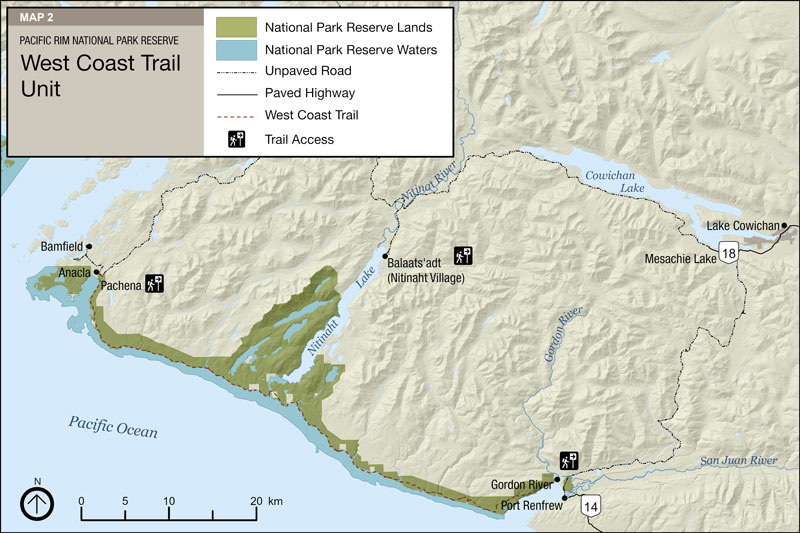
Map – Pacific Rim National Park Reserve: West Coast Trail Unit
This map shows the boundaries of West Coast Trail Unit of Pacific Rim National Park Reserve, on the west coast of Vancouver Island, British Columbia. The West Coast Trail Unit stretches from the top left to the bottom right of the map. The map also depicts the Pacific Ocean to the left of the national park reserve and water bodies throughout the region.
The map identifies communities in the region as follows, roughly from left to right: Bamfield, Anacla, Pachena, Balats’adt (Nitinaht Village), Gordon River, and Port Renfrew. The map also depicts trailhead icons at Pachena, Balats’adt, and Gordon River, as well as transportation access such as paved and unpaved roads.
Executive Summary
The West Coast Trail Unit of Pacific Rim National Park Reserve lies within the ḥaḥahuułi / disib̓aʔk (ancestral territories) of the Huu-ay-aht, Ditidaht, and Pacheedaht First Nations, who have partnered with Parks Canada since 1995 to cooperatively manage the iconic 75-km West Coast Trail and surrounding areas. The 2023 State of the West Coast Trail Unit Report, co-developed by the West Coast Trail Unit management planning working group, provides a comprehensive overview of current conditions and planning considerations to inform the next management plan.
Key Findings
- Visitor Experience: Orientation programs and cultural interpretation initiatives, like the Huu-ay-aht First Nations’ ḥaaḥuupa program, promote awareness of, and respect for, First Nation’s ḥaḥahuułi / disib̓aʔk (ancestral territories). Visitor satisfaction is generally high, though concerns with the condition of infrastructure, such as boardwalks, bridges, and ladders in the West Coast Trail Unit, persist. Agreements are in place between Parks Canada and First Nations, to facilitate employment and training opportunities that support West Coast Trail Unit operations, such as Guardian programs, orientation centres, and ferry services.
- Asset Management: Approximately one third of West Coast Trail Unit assets are rated in poor or very poor condition, based on Parks Canada’s rating system. Remote locations, complex repair logistics, and funding constraints are challenges in the ongoing maintenance of boardwalks, bridges, and ladders.
- Cultural Resources: The West Coast Trail Unit contains many archaeological sites and numerous cultural features, which are vulnerable to erosion, climate change, and vandalism. Monitoring is infrequent and inventories are outdated.
- Ecological Integrity: Ecological monitoring in the West Coast Trail Unit by Huu-ay-aht, Ditidaht, and Pacheedaht First Nations, and Parks Canada, has been underway for many years. Restoration projects, such as in the Cheewaht Basin in Ditidaht disib̓aʔk (ancestral territories), demonstrate successful partnerships. An integrated approach guided by First Nations principles is being considered for future monitoring to share ecological monitoring information and determine collaborative management actions.
- First Nations Relationships: Cooperative management relationships are strong. Improvements in communications, Guardian program support, and long-term funding are identified as important aspects of the future relationship.
Considerations for Management Planning
The West Coast Trail Unit management planning working group identified several planning considerations for the West Coast Trail Unit:
- Promote respectful visitation to First Nation’s territories and support better integration of First Nations’ tourism businesses and economic development plans with existing trip planning websites and information.
- Explore sustainable funding to improve the condition of assets, including considering alternative trail building infrastructure.
- Develop a comprehensive cultural resource monitoring strategy and update archaeological inventories.
- Implement an integrated approach to ecological monitoring that considers both Indigenous and Western scientific perspectives.
- Strengthen economic opportunities for First Nations and collaborative governance within treaty contexts. Sustainable funding for Guardian programs is critical to operations.
Related links
- Date modified :