

Beausoleil Island National Historic Site
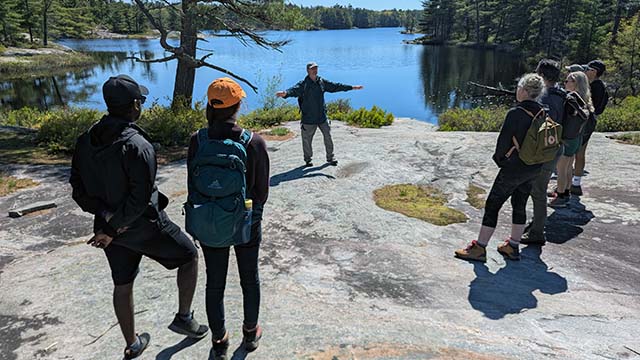
Beausoleil Island, called Bimadinaagogi by the Anishinaabeg, is a special place full of stories, traditions, and history. For thousands of years, it has been used for gathering, ceremonies, and habitation. The island is especially important to women and is part of many creation stories. It helps connect the Anishinaabeg to their land, culture, and way of life.
Historic site background
Beausoleil Island, named Bimadinaagogi (a ridge extending and growing along) by the Anishinaabeg, is representative of the cultural landscape of the Anishinaabeg of the southern Georgian Bay region. The island demonstrates the land’s role as a place of memory, illustrating their people’s relationship with the land, and recalling the Anishinaabe presence in Southern Ontario and their subsequent displacement. It is the setting for traditional narratives that record the island’s creation and meaning. Many traditions associated with the island relate to women, including their use of Beausoleil for gathering berries and other plants, and for traditional ceremonies such as girlhood to womanhood transformation rituals. Witness to a long history of settlement, the evolving landscape of the island includes evidence of ancient camps and of its brief period as a reserve in the mid-19th century when the Anishinaabeg struggled to find new ways to live that were compatible with their traditions and with the rapidly growing Euro-Canadian settlement surrounding them.
As a cultural landscape, Beausoleil Island represents aspects of the relationship that has evolved over the centuries between the Anishinaabeg of the southern Georgian Bay area and their ancestral territories. It is the setting of many Anishinaabe oral traditions and serves as a physical link to the resources, routines and ceremonies that reflect their traditional way of life and anchor their collective memory and culture.
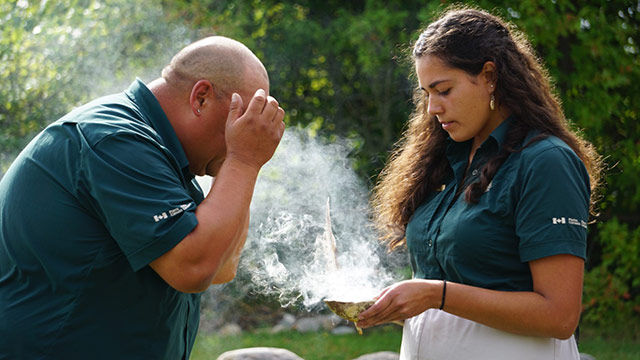
Anishinaabe oral traditions include creation narratives that focus on the island. In one version, two supernatural beings fought over a beautiful young Anishinaabe girl who picked berries in the area. The supernatural beings died in the conflict, their bodies forming Beausoleil and Giant’s Tomb islands. Beausoleil Island is strongly associated with women and their role in Anishinaabe society. The island was a prime source of berries, which were traditionally harvested by young women. The island is also associated with women’s rituals including ceremonies to mark the growth from girlhood to womanhood. These traditions are still maintained.
Archaeological studies have traced millennia of human habitation on Beausoleil Island and have documented the island’s use as a way point on traditional trading routes and a seasonal home for various cultures over time. Ojibway-Anishinaabe nations occupied the south Georgian Bay region from the late 17th century and established seasonal encampments on Beausoleil Island, utilizing its berry resources and the fine fishing areas along its eastern shore. In response to the increasing pressures of Euro-Canadian settlement the Anishinaabeg, under Chief John Assance, surrendered their lands in the Coldwater region of the mainland in 1838 and moved to a new reserve on Beausoleil Island. They were joined by another group led by Ogimaa Peter Gidagigwan. Here they established two settlements and attempted to grow crops in the European manner. The sandy soil, though suitable for temporary and cyclical occupation, was not able to sustain such cultivation. By 1855 most of the Anishinaabeg who lived on Beausoleil Island had moved to nearby Christian Island, though a few families stayed on, preserving an earlier way of life based on hunting, fishing, gardening and berry picking.
Contact us
Administration Office
901 Wye Valley Rd., Box 9
Midland, ON L4R 4K6
Telephone: 705-527-7200
Toll-free: 1-888-773-8888
Email: info.gbi@pc.gc.ca
- Date modified :