
Stratford Festival National Historic Event
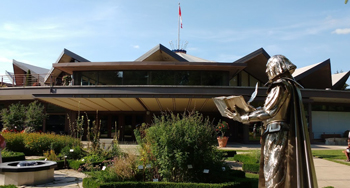
The Stratford Shakespearian Festival was designated a national historic event in 2018.
Historical importance: The establishment of a professional, classical theatre festival in Stratford, Ontario.
Commemorative plaque: 55 Queen Street, Stratford, OntarioFootnote 1
In 1953, Tom Patterson launched an annual festival of Shakespearean theatre in his hometown of Stratford. Artistic Director Tyrone Guthrie and designer Tanya Moiseiwitsch conceived the Festival Theatre’s innovative thrust stage, surrounded by the audience on three sides, which enabled a fluid, dynamic style of performance bringing new life to William Shakespeare’s plays. The Festival, while helping to revitalize Stratford economically, has expanded its repertoire over the years and built an international reputation, training generations of theatre professionals and launching the careers of some of Canada’s finest actors.
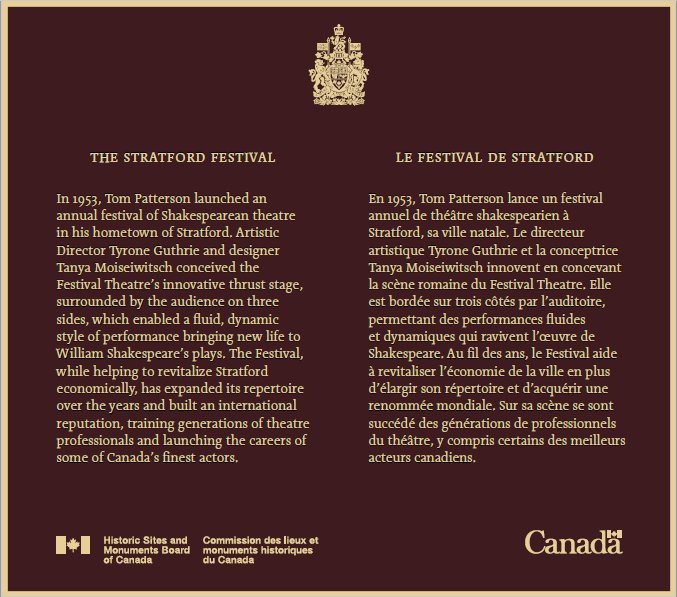
The Stratford Festival
In 1953, Tom Patterson launched an annual festival of Shakespearean theatre in his hometown of Stratford, Ontario. Tyrone Guthrie, the Festival’s first artistic director, and designer Tanya Moiseiwitsch conceived the Festival Theatre’s innovative thrust stage, which is surrounded by the audience on three sides. It enabled a fluid, dynamic style of performance that brought new life to the works of William Shakespeare. Over the years, the Festival helped revitalize Stratford economically, while expanding its repertoire and earning an international reputation for excellence. Attracting outstanding talent from across the country, it contributed to the development of Canadian professional theatre by creating and maintaining a resident company, and providing a place to train and gain experience.
The Stratford Festival emerged out of a period of growth in Canadian theatre, fostered by a vibrant amateur theatre movement, radio drama, and rising cultural nationalism. It was the brainchild of two men: Tom Patterson, who sought to revive the faltering economy of his hometown of Stratford, Ontario, and English director Tyrone Guthrie, who envisioned a Canadian national theatre with a resident company. After its inaugural 1953 season, Stratford quickly acquired a solid international reputation for high-quality classical theatre. In 1957, the Festival Theatre was built, featuring a thrust stage that extends into the audience on three sides, which allows more than 1,800 theatre-goers to watch performances in a semi-circle around the stage.
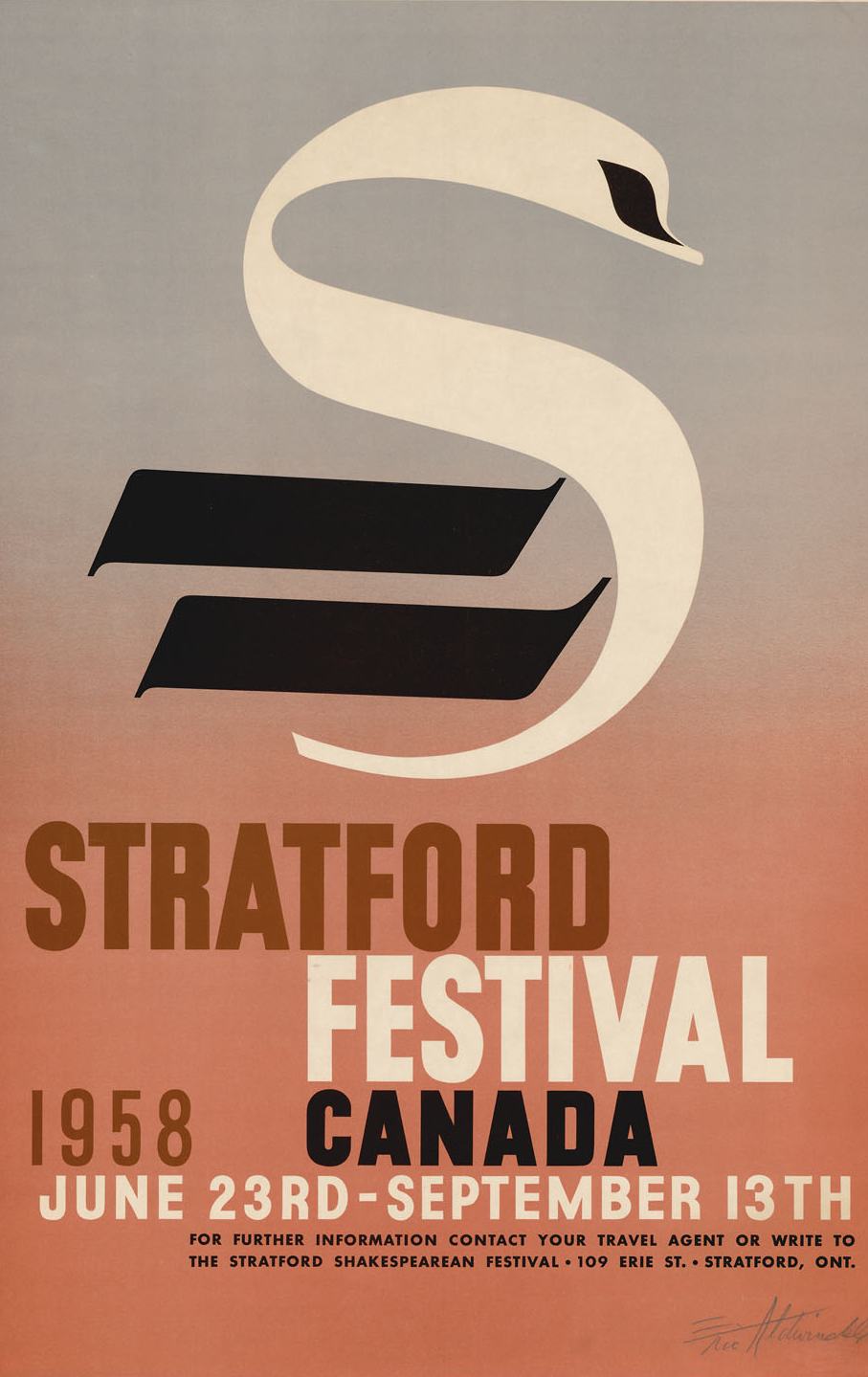
© Library and Archives Canada, R11274-
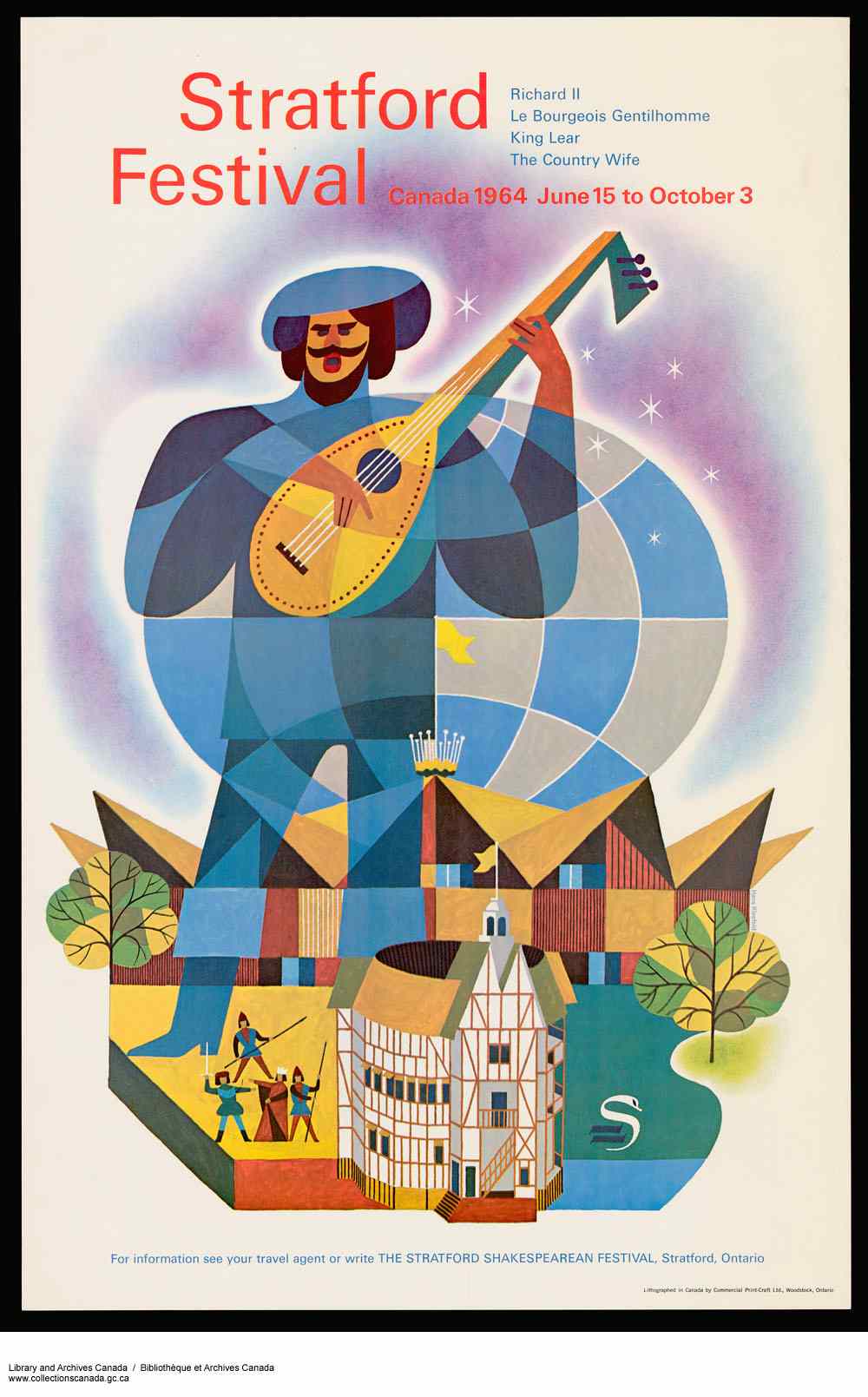
© Library and Archives Canada, R11274-
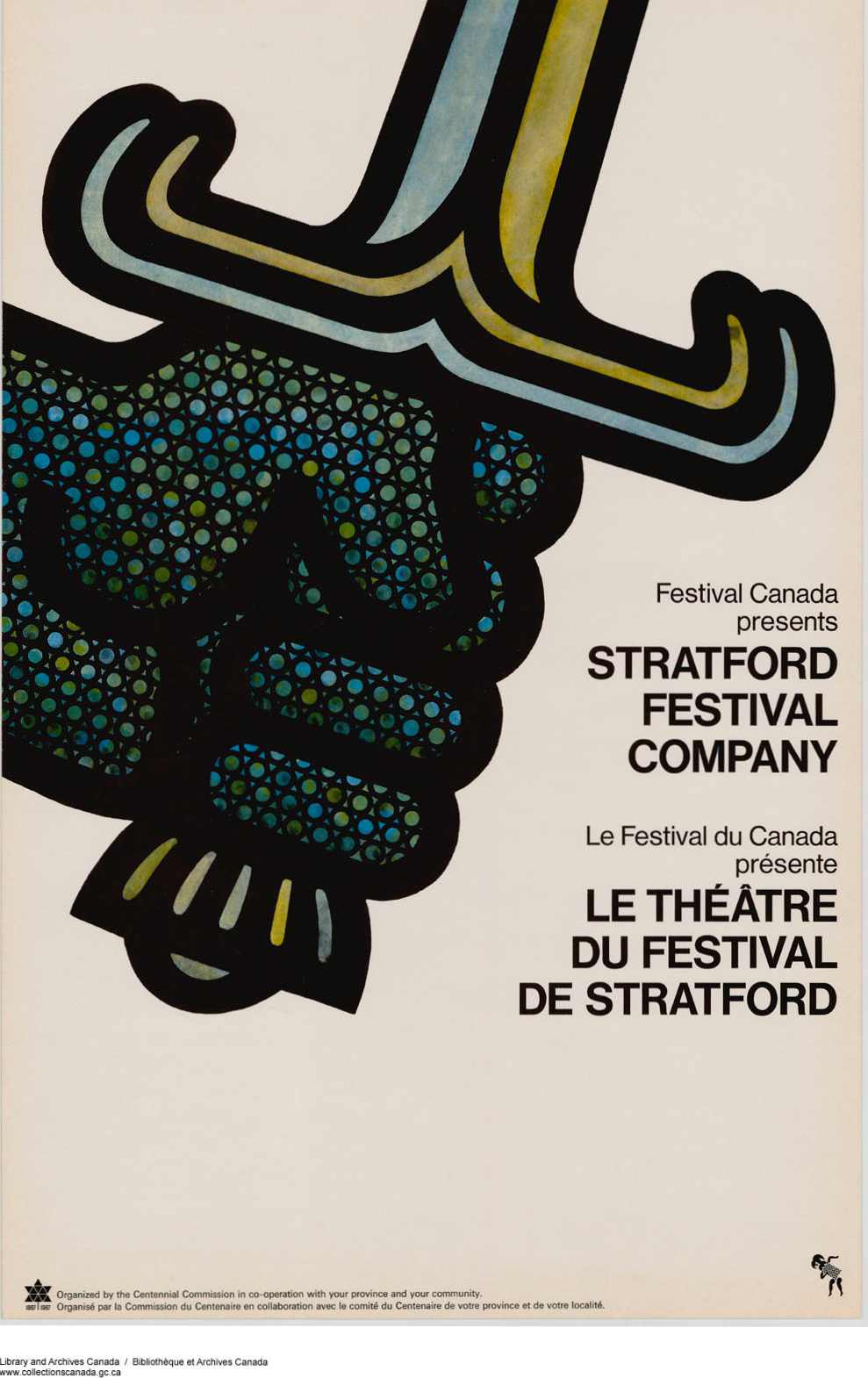
© Library and Archives Canada, Acc. No. 1968-116-
The Festival grew substantially in the following decades and helped launch the careers of notable Canadian actors and directors, including William Hutt, Colm Feore, and Christopher Plummer. Through initiatives like the Birmingham Conservatory for Classical Theatre Training, the Festival provided employment and training for theatrical staff from directors to technicians while helping foster other theatrical companies in Canada. The Festival continued to produce Shakespearean and classical plays while also adding French classics, such as Molière, and musicals.
As envisioned by Patterson, the Festival has become synonymous with Stratford and has transformed the city’s cultural life for residents and visitors alike. The Festival remains a tremendous artistic and economic success, now running from May through to October with more than 700 performances each season.
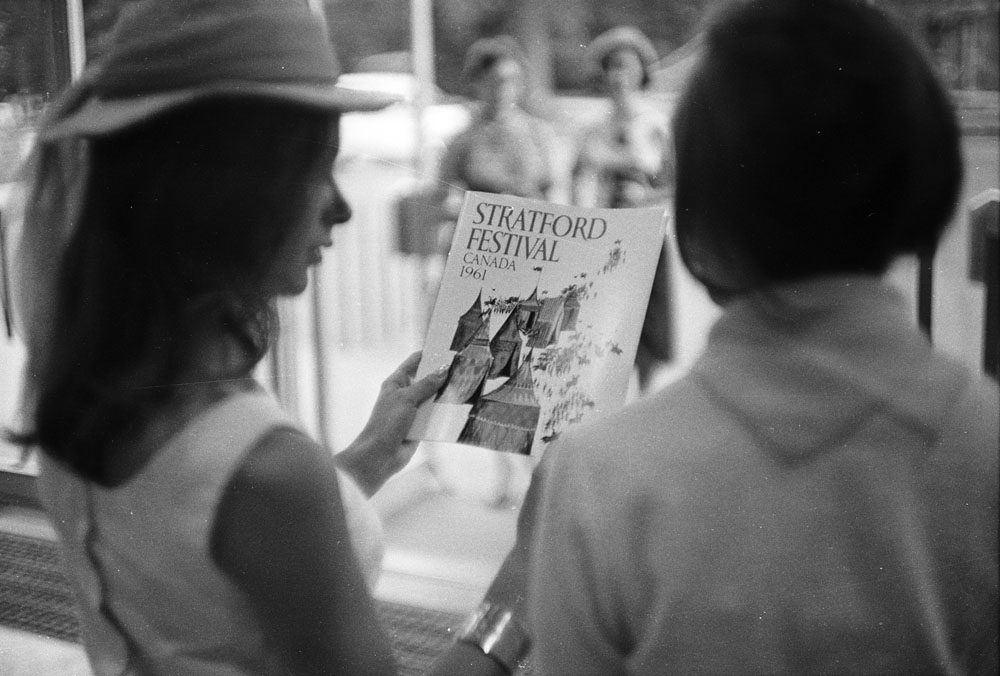
© Library and Archives Canada / National Film Board fonds / e011177507
Backgrounder last update: 2019-02-21
The National Program of Historical Commemoration relies on the participation of Canadians in the identification of places, events and persons of national historic significance. Any member of the public can nominate a topic for consideration by the Historic Sites and Monuments Board of Canada.
Related links
- Abolition Movement in British North America
- Klippert Case, 1967
- Prairie Farm Rehabilitation Administration
- Arrival of Refugees from Vietnam, Cambodia and Laos in...
- Asahi Baseball Team
- Service of the Royal Canadian Air Force (RCAF) during the...
- Breaking Racial Barriers in the National Hockey League
- Nº 2 Construction Battalion, C. E. F.
- Canadarm Deployment in Space, 1981
- Ducks Unlimited Canada
- RCMP Musical Ride
- Celebrations of Emancipation Day
- Coast Salish Knitters and the Cowichan Sweater
- Underground Railroad
- Club de hockey Canadien
- Colored Hockey League of the Maritimes
- The Establishment of the High Commission of Canada in the...
- Charlottetown and Québec Conferences of 1864 National...
- Congrégation de Notre-Dame
- Co-operative Union of Canada
- The Canadian Corps of Commissionaires
- The Stanley Cup National Historic Event
- Vice Admiralty Court of Halifax
- The Creation of Canada’s Permanent Military Force...
- Cunningham v. Tomey Homma
- Discovery of Insulin
- Early Commercial Radio Broadcasting in Canada, 1918-1932
- The Dionne Quintuplets
- West Indian Domestic Scheme (1955–1967)
- The Creation of the National Flag National Historic Event
- Canada’s First Industrial Dairy School
- The Caraquet Riot of 1875
- Black Railway Porters and their Union Activity
- War Brides
- Maple Products
- The Enslavement of African People in Canada
- The Examination Unit (1941–1945)
- Exclusion of Chinese Immigrants, 1923–1947
- The Red River Expedition of 1870 National Historic Event
- Expo 67
- Canadian War Memorials Fund National Historic Event
- Establishment of Ice Roads in the Northwest Territories
- Edmonton Grads
- The Saskatchewan Doctors’ Strike of 1962
- The Spanish Flu in Canada (1918-1920)
- Group of Seven
- Canadians in the Korean War
- Halifax Explosion
- Herschel Island
- The Miramichi Fire of 1825
- Military Nurses
- Victorian Order of Nurses (VON)
- First Women's Institute
- Japanese Experience in Alberta
- Kaplan & Sprachman, Architects
- Liberation of the Netherlands
- National Hockey League
- Upper Canadian Act of 1793 Against Slavery National...
- Toronto Maple Leafs
- The Jamaican Maroons in Nova Scotia
- Meshikamau-shipu Travel Route
- Black Migrations to Sierra Leone (1792 and 1800) National...
- Aboriginal Military Service in the First World War
- The Invention of the Morris Rod-Weeder
- Munitions Production at Defence Industries Limited Factories
- Canadians and the Normandy Landing
- Assiniboine Park and Zoo
- The Arrival of Displaced Persons in Canada, 1945-1951
- Creation of the Northwest Mounted Police
- First aeroplane flying in Canada
- Preston Rivulettes Women’s Hockey Team National Historic...
- The Quong Wing Legal Challenge (1912–1914)
- Shiibaashka’igan – The Jingle Dress
- Rural Electrification Across Canada
- The Sable Island Humane Establishment
- First World War Training at Sarcee Camp
- Early Science in Canada’s North and the Hudson’s Bay Company
- 1972 Summit Series
- Japanese Canadian Soldiers of the First World War and the...
- German U-Boat Attacks at Bell Island
- Winning of the Vote by Women National Historic Event
- The Residential School System
- Amos Indian Residential School (1955–1973) as part of the...
- Assiniboia Residential School (1958–1973)
- Tackaberry Skates (1896-1981)
- First Electric Telegraph
- Newfoundland's Entry into Confederation
- Chinese Construction Workers on the Canadian Pacific...
- Experience of Italian Sojourners National Historic Event
- Black Militia Units in Upper Canada, 1812-1850
- The Universal Negro Improvement Association of Canada...
- Winnipeg Falcons Hockey Club
- Date modified :